

The TCMP Resource Library provides materials for parents, attorneys, researchers, clergy, policymakers, students, and others studying marriage, family law, parental rights, Catholic marriage, religious liberty, and child welfare.
Materials may include:
Materials are organized by subject to make the library useful both to specialists and to visitors encountering these issues for the first time.

Brief public-facing overview — TCMP — Texas Catholic Marriage Project
This article explains why TCMP — Texas Catholic Marriage Project seeks clearer standards for divorce under Texas Family Code § 6.001 and stronger protections for children and parental authority. It examines whether marital conflict has actually destroyed the lawful purposes a particular marriage serves, and why dissolution alone cannot supply the justification for restricting a parent’s rights. Its purpose is to support informed public discussion and legislative reform, while distinguishing existing law from TCMP’s proposed changes.
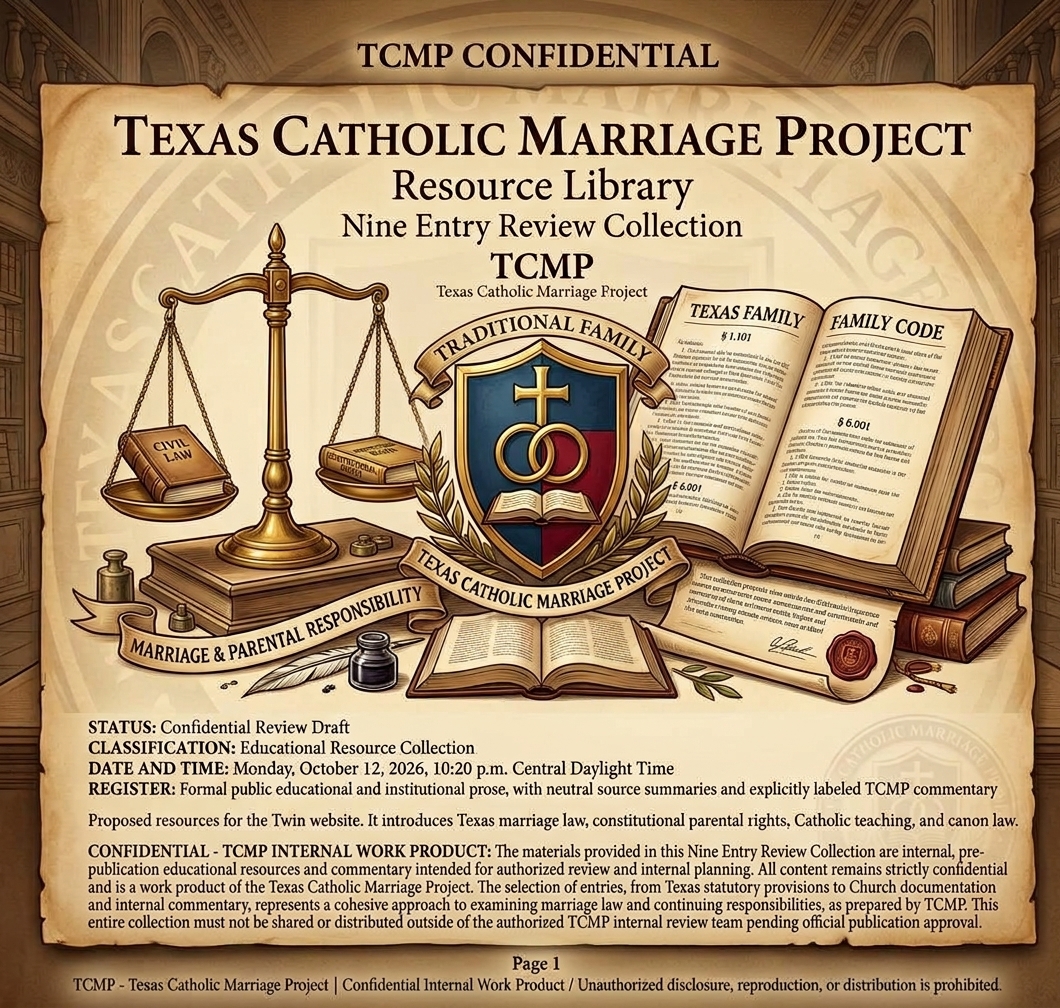
This comprehensive 10-page confidential review draft, compiled by the Texas Catholic Marriage Project (TCMP) on October 12, 2026, serves as an educational resource exploring the intersections between civil family law, constitutional protections, and Catholic doctrine.
What’s Inside the Collection:
Statutory Framework: Examines key Texas Family Code provisions, including the presumption of marriage validity ($\S 1.101$), the no-fault insupportability ground for divorce ($\S 6.001$), and mandatory joinder requirements for parent-child proceedings ($\S 6.406$).
Constitutional Protections: Analyzes foundational judicial precedent such as Troxel v. Granville, focusing on parental liberty, due process, and legal deference to fit parents.
Catholic Teaching & Canon Law: Integrates authoritative documents including the Catechism of the Catholic Church, selected provisions from the Code of Canon Law, Pope John Paul II’s Familiaris Consortio, and Pope Leo XIII’s Arcanum Divinae to address marriage indissolubility, parental educational responsibilities, and family stability.
Dedicated Commentary: Each entry explicitly separates objective legal and historical summaries from TCMP Commentary, highlighting the Project’s internal research, interpretive arguments, and proposed reform positions.
The Texas Catholic Marriage Project’s attorney-review memorandum examines a specific question: when does testimony establish insupportability under Texas Family Code § 6.001, and when is a request for divorce being mistaken for proof of the legal ground? This companion article introduces that inquiry and explains the memorandum’s practical purpose.
Its starting proposition is precise: Cusack did not establish an automatic, irrebuttable
entitlement to divorce through statutory recitation. The statement concerns what that decision actually held. It does not mean that later courts have rejected brief testimony or that a respondent can defeat divorce simply by opposing it.
In Cusack, the husband described circumstances within the marriage, his wife and other witnesses disputed his account, and a jury resolved credibility. The appellate court reviewed the evidence as a whole. Its language making divorce mandatory depended on establishment of the statutory conditions. The opinion did not decide that repeating the statute necessarily ends every factual inquiry. [1]

When one spouse wants a divorce and the other does not, what must the spouse asking for divorce prove? Is saying the marriage is over enough, or must the court examine whether the legal requirements have been met?
Texas allows divorce without proving that either spouse did something wrong. This is commonly called no-fault divorce. Under Section 6.001 of the Texas Family Code, the reason for divorce is called insupportability. The law connects it to discord or a conflict of personalities that destroys the legitimate ends of the marriage and prevents any reasonable expectation of reconciliation.
Reconciliation means getting back together and restoring the marriage. [1]
The phrase legitimate ends concerns the purposes of the marriage that the law recognizes. TCMP questions how courts identify those purposes and decide whether they have been destroyed. The law does not simply say that either spouse’s request automatically proves every requirement.
Texas’s abolition of recrimination does not answer every question about a respondent’s ability to contest insupportability. The central question developed in today’s discussions is whether a court may treat evidence as inadmissible merely because it reveals marital misconduct, even when the respondent identifies a separate, material purpose:
contradicting testimony, demonstrating bias, or disputing the statutory conditions for dissolution.
TCMP’s proposed position is that a no-fault ground must remain a ground proved under law. Removing a requirement to establish fault should not turn disputed assertions into unreviewable conclusions. That position must confront Cusack honestly, including the breadth of the evidentiary argument the court rejected.

Whether the supplied public explanation materially misleads readers by suggesting that a Texas divorce under Family Code § 6.001 cannot be contested as to dissolution itself and that disputes concern only the terms of separation.
Yes. The explanation correctly distinguishes no-fault grounds from agreement about the consequences of divorce and correctly recognizes that mutual consent is unnecessary. Its categorical description of contestability, however, obscures the respondent’s opportunity to challenge the statutory ground. Its suggestion that a petitioner need only state insupportability also blurs pleading and proof. Those are consequential omissions, even though the later cases impose substantial practical obstacles to a successful contest.
The defensible conclusion is limited: a respondent has no veto merely because he or she opposes divorce, but the petitioner remains subject to legal requirements and evidentiary review. The existence of a right to contest does not establish a right to insist on a trial when the applicable procedure permits judgment without a genuine factual dispute.

This memorandum consolidates the available October 28 discussions concerning insupportability and the earlier counsel-retention discussion reflected in Before You Hire Counsel, Review Draft 3, Version 1.2. It incorporates the corrections made during the discussion rather than preserving superseded assertions as conclusions. Retrieval did not supply a complete transcript of every separate conversation from the morning; this document consolidates the visible exchange and the recovered related draft. No case-specific facts, pleadings, or orders have been supplied.
Section 6.001 is contestable: its elements require evidence and the responding spouse must have an opportunity to respond. Texas appellate decisions nevertheless accept relatively brief testimony establishing those elements. One decision also upheld partial summary judgment despite the responding spouse’s belief that reconciliation remained possible. Those holdings explain the practical obstacle but do not independently resolve which burden of proof is constitutionally required. The appellate standard of review and constitutional level of scrutiny are separate. Rational-basis review does not govern every claim merely because it arises in a divorce proceeding; the applicable test depends on the right asserted, challenged government action, governing doctrine, and procedural posture.

The court must identify the particular claim and challenged action before selecting the governing test. Rational-basis scrutiny of a legislative policy does not answer whether an individual received due process or whether a particular parental or religious restriction satisfies its governing doctrine. Constitutional legal questions ordinarily receive de novo review; supported factual findings and discretionary decisions may receive deference. [1–3, 5, 9]
On the available account, the most concrete issues for investigation are notice, actual consent at rendition, authority for waivers, the evidentiary record, and the basis for each exclusive parental allocation. Heightened scrutiny is an argument to establish claim by claim. A viable procedural vehicle is indispensable: this memorandum does not conclude that the March 2006 decree can now be reached by ordinary appeal.

Grossman and Green demolish a caricature: an indiscriminate return to the worst features of historical fault litigation. They do not answer TCMP’s actual position. TCMP does not defend perjury, fabricated cruelty, procedural entrapment, or the denial of safe exits to abuse victims. It demands defined statutory predicates, honest proof, meaningful findings, immediate safety remedies, religious neutrality, and independent consideration of children before the State dismantles an intact legal household over objection.
The Grossman paper repeatedly substitutes policy rhetoric for legal analysis. It treats a spouse’s desire to leave as sufficient proof that every operative element of section 6.001 has been established; treats historical misconduct by witnesses and lawyers as a reason to dispense with measurable proof; invokes domestic violence to defend a statute that requires no allegation or finding of violence; and discusses children chiefly as casualties of fault litigation while ignoring the State-imposed restructuring that follows dissolution. Its central constitutional assertion – that no respondent has a due-process right to defend against the proposition that a marriage has failed – assumes the very conclusion that adjudication is supposed to establish.

Whether Texas Family Code § 6.001 should be construed to require a threshold determination that the legitimate ends of the marital relationship have actually been destroyed before the court proceeds to consider discord or conflict of personalities as a basis for insupportability.
TCMP proposes that the court first decide whether the legitimate ends of the marital relationship have actually been destroyed. If the court determines they have not been destroyed, the § 6.001 insupportability claim fails. No further inquiry into discord or conflict of personalities is needed to establish that ground. This is a proposed mandatory sequencing rule, not a procedural requirement expressly stated in the statute or established here as controlling precedent.

A 50/50 possession schedule alone does not change any of the eleven allocations identified in the decree. It changes the distribution of physical possession while leaving the specified authority over residence, treatment, education, legal affairs, finances, and passport applications intact. A parent can therefore receive equal time while remaining excluded from equal participation in major decisions whose consequences operate throughout the child’s life.
Nor does equal time itself ensure timely information about the other household or continuous access to a protective caregiver. TCMP’s position is that an equal schedule is an incomplete response to questions of family preservation, parental authority, and child security. A proposal that expressly reallocates decisionmaking powers must be assessed according to its actual terms; the analysis here concerns equal physical possession standing alone.

On those facts, no basis for prohibition has been established. Texas Family Code §
151.001(a)(7) recognizes parental authority to represent a child in legal actions and make
decisions of substantial legal significance concerning the child. The respondent holds that authority before the suit begins. The petitioner’s filing does not itself transfer it to her or extinguish his ability to arrange counsel.
Private retention is distinct from requesting a court-appointed attorney ad litem. A restriction must rest on an identified legal ground supported by the facts, rather than the respondent’s opposition to dissolution or the availability of court-appointed representation.

The petitioner’s allegation does not establish that the parents’ earlier judgment was
mistaken or that dissolution better serves the children. Nor does her filing alone displace
the respondent’s existing parental authority to arrange legal representation for them.
Section 6.001 establishes insupportability as a ground for dissolution. Section 6.402(a)
permits pleading that ground substantially in statutory language without specifying
underlying evidentiary facts. Tex. Fam. Code Ann. §§ 6.001, 6.402(a).
Pleading the ground is not proof that dissolution better serves the children. The allegation
does not rebut the factual basis of the parents’ prior shared judgment.
That prior agreement supplies the factual baseline for this analysis.

The petitioner seeks a judgment dissolving the marriage; the children’s preservation
position seeks continuation of the family sustained by that marriage. Those requested
outcomes directly oppose one another.
The conflict concerns the relief sought and the interests affected. It does not depend on
attributing improper motives to the petitioner. Her personal interest in obtaining
dissolution cannot be treated as equivalent to the children’s interests in preserving their
family.